
Tim Chien
Senior Manager Public Relations and Press Officer Media & Communications
+886-2-7735-7507 chien.tim@taiwan.ahk.de
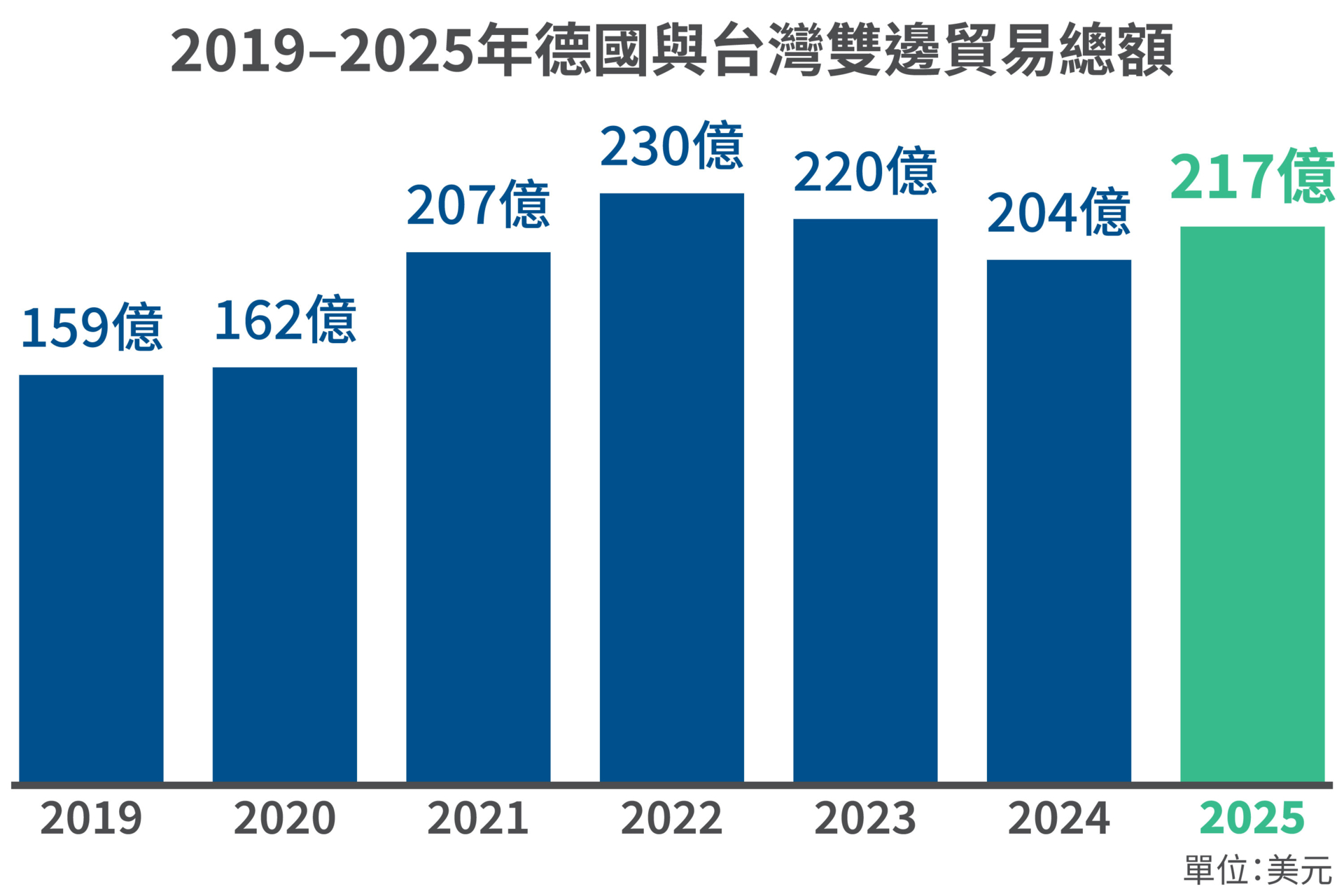
According to the latest statistics released by Taiwan’s Ministry of Finance, trade between Taiwan and Germany remained robust in 2025, with total bilateral trade reaching USD21.7 billion, representing a year-on-year growth of 6.0% compared to 2024. Since first surpassing the USD20 billion mark in 2021, bilateral trade between the two economies has remained above this level for five consecutive years, underscoring the stability of their economic ties and a solid foundation for long-term development.
Highly Complementary Trade Structure: High-Tech Exports and Precision Equipment Imports Advance in Parallel
Data show that Taiwan’s exports to Germany amounted to approximately USD7.4 billion in 2025. Machinery and electrical equipment accounted for more than 60% of this total, reaching USD4.5 billion. Benefiting from the global expansion of AI infrastructure and ongoing digital transformation, exports of parts of electronic product grew by 24.1% year-on-year, while information, communications, and audio-video products increased by 9.0%. These figures reflect Germany’s sustained and stable demand for Taiwan’s semiconductors and key electronic components.
On the import side, Taiwan’s total imports from Germany reached USD14.3 billion. In addition to traditional categories such as vehicles, aircraft vessels and associated transport equipment (USD3.0 billion) and chemicals (USD2.1 billion), exports of German electrical machinery products to Taiwan surged by 91% year-on-year. This significant increase reflects Taiwan’s rising demand for high-end power equipment and precision manufacturing machinery amid semiconductor capacity expansion, smart manufacturing upgrades, and the ongoing energy transition.
Investment Momentum Accelerates: German Companies Deepen Their Commitment to Taiwan
According to statistics from Taiwan’s Dept. of Investment Review, MOEA, German approved investment in Taiwan reached USD209 million in 2025, marking a year-on-year increase of 264%. This strong growth indicates that, despite ongoing global supply chain restructuring and a struggling German economy, German companies continue to regard Taiwan as one of their most important strategic hubs for technology and R&D in the Asia-Pacific region, while further deepening their operational presence and investment footprint on the island.
Dr. Eva Langerbeck, Chief Representative and Executive Director of the German Trade Office Taipei, commented:
“Germany–Taiwan bilateral trade has remained above the USD20 billion threshold for five consecutive years. This is not merely an accumulation of figures, but a clear testament to the strong complementarity of our industrial structures. We see cooperation expanding beyond traditional goods trade into a wide range of fields, including semiconductor supply chains, green energy, and smart mobility.” She further noted: “Germany and Taiwan have become indispensable technology partners to one another. Going forward, we will continue to promote exchanges in areas such as net-zero solutions and smart automation, helping companies from both sides develop high value-added collaborative models amid ongoing global supply chain adjustments.”
German Trade Office Taipei to Host 2026 Economic Outlook Conference and Release Latest Business Confidence Survey
To help companies better understand future economic trends, the German Trade Office Taipei will host the “GTO Economic Outlook 2026” on March 5, and will simultaneously release the latest Business Confidence Survey Report 2025/2026. The conference will bring together representatives of German companies in Taiwan as well as industry experts to discuss the current economic landscape and key challenges facing both Germany and Taiwan. Participants will also share forward-looking insights on major industries and analyze important trends under the evolving political and economic environment, supporting companies in making more informed strategic decisions.
Looking ahead, as demand for digital transformation, energy transition, and smart manufacturing continues to grow, cooperation between Germany and Taiwan in areas such as semiconductors, smart machinery, advanced manufacturing, green technologies, and innovative applications is expected to expand further. Bilateral economic relations will not only continue to grow in scale but also move toward higher value creation and deeper industrial collaboration.
Senior Manager Public Relations and Press Officer Media & Communications
+886-2-7735-7507 chien.tim@taiwan.ahk.de